Hardwired to Hesitate: Rewiring Your Brain's Survival Response So Stress Sharpens Your First Aid Skills Instead of Destroying Them
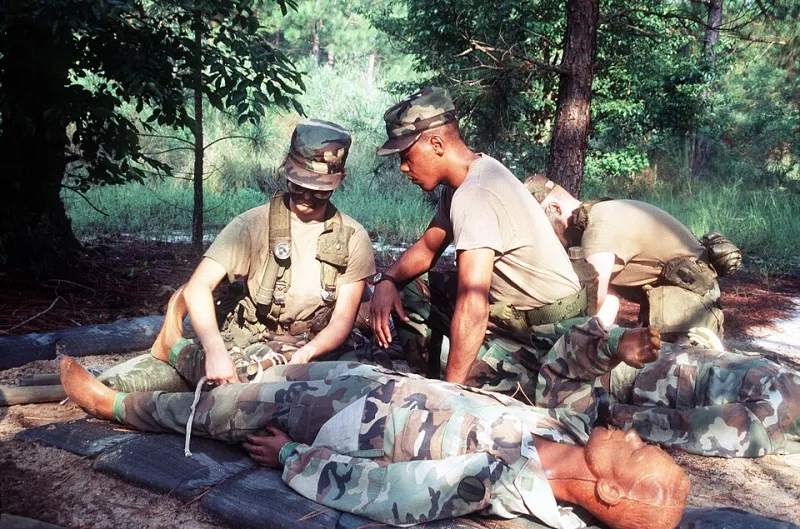
Photo: Department of Defense. American Forces Information Service. Defense Visual Information Center. 1994, Public domain, via Wikimedia Commons
It is a finding that surprises nearly everyone who encounters it for the first time: in certain high-stress emergencies, individuals with formal first aid certification sometimes perform more poorly than bystanders who have never taken a single course. They freeze longer. They misapply techniques they have practiced dozens of times. They forget sequences they could recite perfectly the day before.
This is not a failure of intelligence or commitment. It is a failure of neuroscience—specifically, a failure to account for what extreme stress does to a trained human brain. And understanding that failure is the first step toward correcting it.
The Neuroscience of a Collapsing Response
When you encounter a genuine emergency—a coworker slumped at their desk, a child choking in a restaurant—your brain does not calmly retrieve the lesson plan from your last certification class. Instead, a cascade of neurological events begins in milliseconds.
The amygdala, the brain's threat-detection center, fires before your prefrontal cortex—the seat of rational decision-making—has a chance to process what is happening. Stress hormones including cortisol and adrenaline flood your system. Your heart rate spikes. Blood flow is redirected toward large muscle groups and away from the fine motor control systems that first aid demands. Your visual field narrows. Working memory, the mental workspace where you hold and apply instructions, shrinks dramatically.
Researchers studying tactical medicine and military combat medicine have documented this phenomenon extensively. At heart rates above approximately 145 beats per minute, fine motor skills begin to deteriorate. Above 175 beats per minute, complex cognitive functions—the kind required to remember a multi-step CPR protocol or correctly apply a tourniquet—can become severely compromised in individuals who have not trained specifically against this physiological state.
The cruel irony is that certification courses typically teach skills in calm, controlled environments. The brain encodes those skills in a calm, controlled neurological state. When the real emergency arrives and the neurological state transforms entirely, retrieval of those skills becomes genuinely difficult.
The Fight-Flight-Freeze-Fawn Spectrum in Emergency Response
Most people are familiar with the fight-or-flight response. Fewer are aware that the spectrum of survival responses is considerably broader, and that different individuals under different circumstances will respond very differently to acute threat.
Fight responses may cause a bystander to act impulsively and aggressively—performing compressions with far too much force, or attempting to move an injured person before assessing for spinal injury.
Flight responses manifest as physical or psychological withdrawal from the scene—the trained responder who walks to the back of a crowd and tells themselves someone else will handle it.
Freeze responses, perhaps the most commonly discussed, produce the paralysis that prevents action entirely. The responder stands motionless, aware that they should act but neurologically unable to initiate movement.
Fawn responses—less often discussed in emergency medicine contexts—involve excessive deference to others at the scene, even when those others are less qualified. A certified responder may defer to a panicked family member who insists on a course of action that is medically counterproductive, simply because the social pressure of the moment overrides trained judgment.
Recognizing which response you are most likely to exhibit is the foundation of effective mental conditioning.
What Tactical Medicine and Sports Psychology Teach Us
The fields of tactical emergency casualty care and elite athletic performance psychology have independently arrived at overlapping conclusions about how to maintain skill execution under extreme physiological stress. Their shared insight: the brain must be trained in conditions that approximate the stress of real performance, not just the content of the skill.
Several evidence-based techniques have demonstrated measurable benefits for civilian first responders.
Stress Inoculation Training
Stress inoculation involves deliberately practicing emergency skills while under controlled physiological stress. You do not need a simulation lab to begin this process. At home, you can perform the following: complete two minutes of vigorous exercise—jumping jacks, burpees, or running in place—until your heart rate is significantly elevated, then immediately attempt to walk through your CPR sequence, apply a practice tourniquet, or verbally narrate the steps of a choking intervention.
The discomfort of performing cognitive tasks while physically stressed is precisely the point. Over repeated sessions, your brain begins to encode the skill in a higher-arousal neurological state, making retrieval more reliable when adrenaline arrives uninvited.
Tactical Breathing and Heart Rate Modulation
Box breathing—inhaling for four counts, holding for four counts, exhaling for four counts, holding for four counts—has been adopted by law enforcement, military personnel, and emergency medical professionals as a reliable method for rapidly reducing heart rate and restoring prefrontal cortex function during acute stress.
Practicing this technique regularly, and specifically practicing it before skill rehearsal, trains the brain to associate it with a return to functional calm. In a real emergency, even two or three cycles of box breathing before initiating care can meaningfully improve performance.
Mental Rehearsal with Scenario Specificity
Athletes have used visualization for decades, and the neurological basis for its effectiveness is well established. When you mentally rehearse a physical skill in vivid detail, the brain activates many of the same neural pathways used in actual performance.
For first aid purposes, mental rehearsal should be specific and scenario-varied. Do not simply imagine performing CPR in the abstract. Imagine performing it on the floor of your kitchen, in a parking lot, at a crowded family gathering. Imagine the noise, the emotional weight, the presence of bystanders. Imagine your hands shaking and continuing anyway. This kind of rehearsal builds neural pathways that include the emotional context of real emergencies.
Chunking and Verbal Anchoring
Complex multi-step protocols are particularly vulnerable to stress-induced memory failure. Cognitive chunking—grouping steps into labeled clusters—reduces the working memory load required to execute them.
Developing a personal verbal anchor phrase for each chunk can also help. When you begin compressions, saying aloud or internally, "Push hard, push fast" activates a learned association that can carry you through the sequence even when higher-order cognition is compromised. Many tactical medicine instructors train students to narrate their actions aloud precisely because vocalization engages a different neural pathway than silent recall.
Building a Home Practice Routine
None of these techniques require expensive equipment or professional supervision to begin. A consistent home practice of fifteen to twenty minutes, two to three times per week, can produce meaningful improvements in stress-resilient skill performance over the course of several months.
A basic routine might include:
- Two minutes of elevated-heart-rate exercise to simulate physiological arousal
- One full mental rehearsal scenario, narrated internally in specific sensory detail
- One physical skill run-through—using a CPR mannequin, a practice tourniquet, or simply the physical motions of chest compressions on a firm surface
- Three cycles of box breathing to conclude, reinforcing the association between controlled breathing and skill readiness
Keeping a simple log of these sessions can also be valuable. Reviewing it periodically reminds you that preparation is ongoing, not a one-time certification event.
The Hero Who Keeps Performing
The goal of this kind of training is not to eliminate the stress response—that would be neither possible nor desirable. Adrenaline, properly harnessed, sharpens certain aspects of performance. The goal is to raise the threshold at which stress becomes disruptive, and to ensure that when the threshold is crossed, your skills are encoded deeply enough to survive it.
Every community benefits when its members are not merely certified but genuinely prepared—prepared in the neurological sense, trained to act when their own brain is working against them. That kind of preparation does not come from a single Saturday course. It comes from consistent, deliberate practice that takes the brain's biology seriously.
You have the capacity to be that kind of prepared. The science simply asks that you train accordingly.