Certified but Frozen: Why First Aid Training Alone Does Not Guarantee Action in a Real Emergency

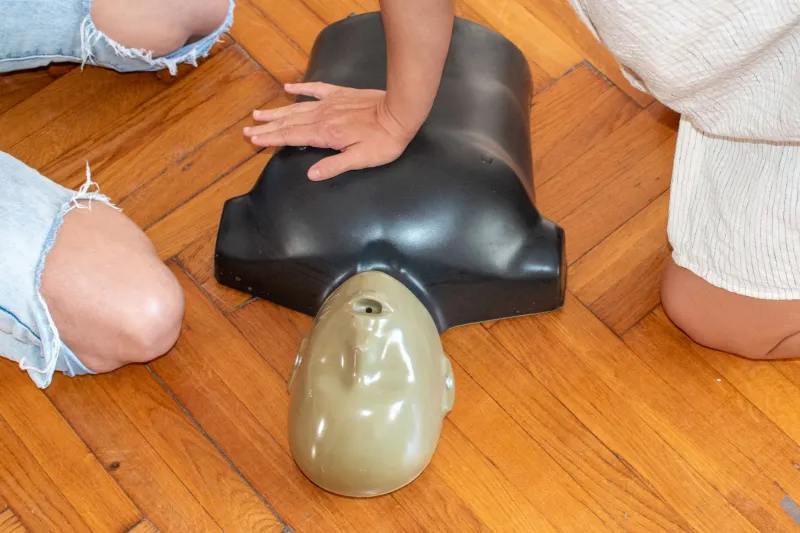
Photo: Giles Laurent, CC BY-SA 4.0, via Wikimedia Commons
The Troubling Gap Between Knowledge and Action
Every year, hundreds of thousands of Americans complete first aid and CPR certification courses. They learn chest compression ratios, practice on mannequins, and leave the classroom feeling confident. Yet when cardiac arrest or a choking emergency actually occurs in front of them — at a family gathering, in a grocery store, on a crowded subway platform — a significant proportion of those same certified individuals stand still, look around, or wait for someone else to step forward.
This is not a fringe phenomenon. Studies examining bystander CPR rates in communities with robust public training programs have repeatedly found that certification does not reliably predict intervention. One large-scale review published in the journal Resuscitation found that bystander CPR rates remained disappointingly low even in regions where training was widely available. The problem, researchers concluded, was not knowledge — it was the translation of that knowledge into timely, decisive action under real-world conditions.
For an organization dedicated to empowering everyday heroes, this gap represents one of the most consequential challenges in emergency preparedness. If trained individuals do not act, the community loses the very resource it invested in building.
Why the Trained Mind Still Hesitates
The reasons trained rescuers freeze are layered and often counterintuitive. Understanding them is essential to overcoming them.
The illusion of competence. Certification courses, by necessity, take place in controlled environments. The mannequin does not bleed, panic, or stare back at you. The classroom is quiet. There is an instructor nearby. These conditions create a form of competence that is real but context-dependent. When the actual emergency is loud, chaotic, and emotionally charged, the mental pathways built in training may not fire with the same reliability.
Diffusion of responsibility. Social psychologists have documented this phenomenon for decades, most famously in studies following the 1964 Kitty Genovese case in New York City. When multiple bystanders are present, each individual tends to assume that someone else will act — or already has. Paradoxically, the larger the crowd, the less likely any single person is to intervene. Certified rescuers are not immune to this effect. Even someone who completed a CPR course last month may unconsciously defer to the group.
Fear of doing harm. Many trained individuals report holding back because they are afraid of making a mistake — cracking a rib during compressions, moving someone with a potential spinal injury, or misjudging whether a person is truly unconscious. This fear is understandable, but it is also largely misplaced. For a person in cardiac arrest, the risk of inaction vastly outweighs the risk of imperfect intervention. Good Samaritan laws in all 50 states provide legal protection for rescuers acting in good faith, yet awareness of these protections remains surprisingly low among the general public.
Ambiguity about the situation. Real emergencies rarely announce themselves with clarity. A person slumped in a chair might be sleeping. A man clutching his chest might be experiencing indigestion. Trained individuals, uncertain whether an emergency is actually occurring, often wait for clearer signals — and those signals sometimes come too late.
Emotional overwhelm. When the person in distress is a stranger, the emotional stakes are already high. When it is a family member or close friend, they can become paralyzing. Research on stress and cognitive performance consistently shows that high emotional arousal narrows attention and disrupts access to procedurally learned skills, particularly when those skills have not been practiced under any form of realistic pressure.
The Mental Rehearsal Advantage
Elite athletes, military personnel, and emergency medicine professionals all rely on a technique that most first aid certification programs barely mention: deliberate mental rehearsal. Also called mental simulation or visualization, this practice involves systematically imagining yourself moving through an emergency response — not as a vague hope, but as a detailed, step-by-step mental performance.
Research in sports psychology and military training has consistently demonstrated that mental rehearsal activates many of the same neural pathways as physical practice. When the real event occurs, the brain has already, in a meaningful sense, been there before. The hesitation gap narrows because the situation feels less foreign.
For a certified rescuer, this might look like spending five minutes each week picturing a specific scenario: a colleague collapses in the break room, you assess responsiveness, you call for help, you begin compressions. The scene should be vivid — the fluorescent lighting, the sound of the coffee maker, the texture of the floor. The more sensory detail you incorporate, the more effectively the rehearsal prepares the brain for the real thing.
Practical Strategies for Breaking Through Paralysis
Mental rehearsal is powerful, but it works best alongside other concrete strategies.
Designate yourself in advance. Before entering a crowded public space — a stadium, a concert venue, an airport terminal — make a quiet internal commitment: If something happens here, I will be the one who acts. This pre-commitment counters the diffusion of responsibility effect by removing the implicit negotiation that happens in a crowd.
Learn to name the hesitation. In the moment of an emergency, if you feel yourself freezing, try to recognize it explicitly: I am hesitating. This is a known response. I can move through it. Naming the freeze disrupts its grip and creates a brief cognitive opening that trained behavior can fill.
Practice the first step only. Paralysis often stems from the overwhelming sense that you must do everything at once. Instead, commit only to the first action — kneeling down, calling out to the person, picking up the phone. Movement generates momentum. The second step becomes easier once the first has been taken.
Assign responsibility directly. If you are the first to recognize an emergency in a group setting, do not call for help in general terms. Point to a specific individual and say, "You — call 911 now." Direct assignment cuts through the diffusion effect and mobilizes bystanders far more effectively than a generalized plea.
Refresh your training regularly. The American Heart Association and American Red Cross both recommend recertification every two years, but the psychological benefits of practice erode faster than that. Even informal refreshers — watching a skills video, running through steps verbally, attending a community demonstration — help maintain the mental accessibility of trained responses.
Certification Is the Beginning, Not the End
A first aid or CPR certification is a genuine achievement, and the knowledge it conveys is genuinely valuable. But the certificate on your wall does not automatically make you an effective responder. That transformation requires an additional layer of preparation — one that addresses not just what to do, but the internal barriers that prevent trained people from doing it.
The communities that save the most lives are not simply those with the highest certification rates. They are communities where trained individuals have also done the psychological work: rehearsing scenarios, examining their own hesitation patterns, and committing in advance to act. That is the difference between a credential and a capability.
If you hold a certification, consider this your prompt to go one step further. Spend a few minutes this week imagining yourself responding to an emergency. Name the barriers that come up. Practice the first step. And the next time a real emergency unfolds in front of you, your brain will already know the way.