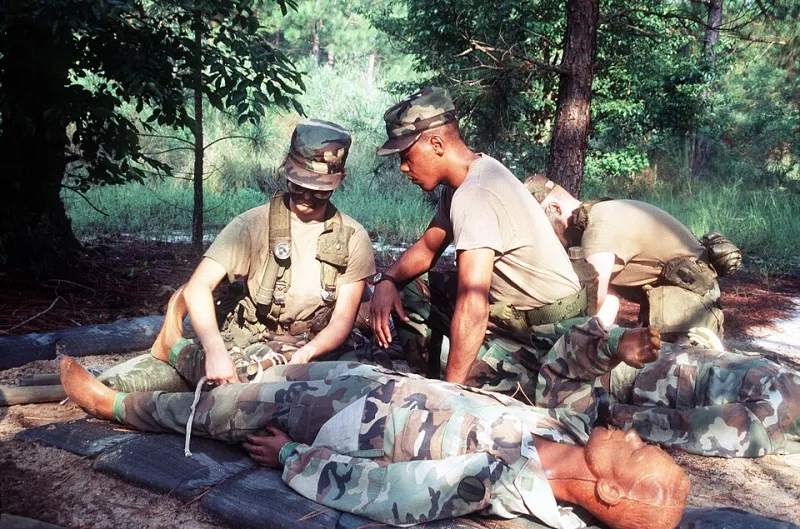
The First Aid Skills No Kit Can Hold: Mastering the Mental and Communication Tools That Turn Bystanders into Effective Rescuers
Photo: Internet Archive Book Images, No restrictions, via Wikimedia Commons
Walk into any pharmacy or sporting goods store in America and you will find first aid kits in every configuration imaginable—compact pouches for a glove compartment, elaborate wall-mounted cabinets for offices, waterproof cases for outdoor adventures. The contents are largely predictable: bandages, gauze, antiseptic wipes, perhaps a CPR face shield or a pair of nitrile gloves.
What no kit contains—what no kit can contain—is the set of competencies that most frequently determines whether a bystander's intervention succeeds or fails in a genuine emergency. These are not physical tools. They are cognitive, communicative, and psychological capacities that operate invisibly, often below the level of conscious awareness, in the moments when everything is happening at once.
Emergency medicine professionals and researchers who study bystander response consistently identify a pattern: the individuals who perform most effectively at unplanned rescue scenes are not always those with the most technical training. They are those who can think clearly, communicate precisely, manage their own emotional state, and organize the people around them. These are learnable skills. They are simply rarely taught.
The Chaos Tax: What Noise, Crowds, and Emotion Cost You
Imagine the scene: a man has collapsed in a crowded food court. A dozen people have gathered. Two are filming on their phones. One is shouting that he needs water. A child nearby is crying. Someone is already on the phone with 911 but cannot hear the dispatcher clearly. Another person is attempting to lift the man off the floor.
This is not an unusual scenario. It is, in fact, a fairly typical representation of what unmanaged bystander scenes look like. And it illustrates what might be called the chaos tax—the cognitive and practical cost of operating in a disorganized environment where well-meaning people are working at cross-purposes.
Every piece of noise, every competing instruction, every unnecessary physical intervention consumes mental bandwidth that the person attempting to provide care needs for the task at hand. Managing the scene is not a secondary concern. It is a primary one.
How to Take Command Without a Badge
One of the most counterintuitive findings in bystander response research involves authority. In a crowd of strangers, most people are waiting for someone to take charge. They are not waiting for the most credentialed person—they have no way to evaluate credentials. They are waiting for the person who acts with the clearest sense of purpose and communicates with the most confidence.
Taking command of a scene does not require aggression or a uniform. It requires specificity and directness. There is a well-documented phenomenon in emergency psychology sometimes called the bystander diffusion effect, in which vague appeals for help—"Someone call 911!"—are less effective than direct, individualized requests. The mechanism is simple: when responsibility is diffused across a group, each member of the group assumes someone else will act.
The corrective is equally simple. Rather than appealing to the crowd, address individuals directly and assign specific tasks.
"You, in the blue jacket—call 911 right now and stay on the line." "You, with the red bag—find the AED. It's near the entrance." "Everyone else, please step back and give us space to work."
This kind of directive communication accomplishes three things simultaneously: it assigns clear responsibility, it reduces the number of people in the immediate workspace, and it signals to the person receiving care that someone is in control. That signal alone has measurable psychological value for the patient.
Giving Instructions Under Pressure: The Art of Clear Communication
Directing a crowd is one communication challenge. Coaching an untrained bystander through a physical intervention is another, and in many ways a more demanding one.
In scenarios where the most qualified person present cannot physically perform the intervention—because they are managing the airway while someone else needs to do compressions, for example—the ability to give accurate, real-time verbal guidance becomes critical. This skill is rarely practiced and rarely taught in standard certification courses.
Effective instruction under pressure shares several characteristics. It uses plain language, not medical terminology. It is delivered in short, discrete units rather than long explanatory sequences. It confirms comprehension before moving on. And it maintains an even, steady tone even when the situation is urgent—because a panicked instructor produces panicked students.
"Put the heel of your hand in the center of his chest. Now push down hard. Harder. Keep going—I'll count with you."
Practicing this kind of verbal coaching, even in informal settings with family members or friends, builds a kind of communicative muscle memory that is genuinely useful in emergencies. Consider running through a scenario at home: one person plays the responder, another plays the untrained bystander receiving instructions. The discomfort of the exercise is part of its value.
Recognizing Your Own Limits: The Discipline of Stepping Back
There is a particular kind of courage involved in continuing to act under pressure. There is an equally important, and less celebrated, kind of courage involved in recognizing when you should stop.
Responder fatigue is a real phenomenon, and it affects bystanders as well as professionals. CPR performed incorrectly because the rescuer is exhausted is less effective than CPR performed correctly by a fresh responder. Decisions made by someone who is emotionally overwhelmed are frequently worse than decisions deferred to someone who has had a moment to regulate.
Knowing your limits requires honest self-assessment—not in the abstract, but in real time, while the emergency is unfolding. It means asking yourself: Am I still performing this correctly? Is my judgment still sound? Is there someone nearby who is better positioned to take over?
Handoff of care is a skill, and like all skills, it benefits from deliberate practice. A clean handoff includes three elements: a brief status report ("He's been getting CPR for about three minutes, no response yet"), a transfer of the specific task ("Take over compressions—place your hands here"), and confirmation that the incoming responder is oriented ("Do you have it?").
This sequence, practiced until it is fluent, allows care to continue without interruption while the original responder steps back, regulates, and either re-engages or supports from a different role.
Emotional Regulation as a First Aid Skill
The emotional dimension of emergency response is perhaps the most systematically underaddressed element of bystander preparedness. The experience of witnessing or responding to a traumatic event produces a physiological and psychological response that does not simply resolve when the emergency ends.
In the immediate term, emotional dysregulation—the experience of feeling overwhelmed, panicked, or dissociated—impairs performance in measurable ways. Techniques for managing this in the moment include controlled breathing (see the box breathing technique discussed in related Save Heroes coverage), grounding strategies such as focusing on a specific physical sensation, and the simple act of narrating your actions aloud, which engages the language centers of the brain and can help counteract the amygdala-driven panic response.
Over the longer term, responders—including civilian bystanders who have been involved in serious emergencies—benefit from debriefing, whether formal or informal. Talking through what happened, what you did, and how you felt is not a sign of weakness. It is a recognized component of psychological resilience that reduces the risk of longer-term distress.
The Invisible Kit
The most prepared person at any emergency scene is not necessarily the one carrying the most equipment. It is the one who can think clearly when others cannot, speak precisely when communication is breaking down, recognize what they do not know and act accordingly, and support the people around them as effectively as they support the patient.
These capacities do not appear automatically with certification. They are built through deliberate practice, honest self-reflection, and the willingness to treat mental and communicative preparedness as seriously as physical technique.
Your first aid kit is a starting point. The invisible kit—the one you carry in how you think, how you speak, and how you manage yourself under pressure—is what makes the difference.