Frozen in a Crowd: The Hidden Psychology That Stops You From Calling 911—And How to Break Through It
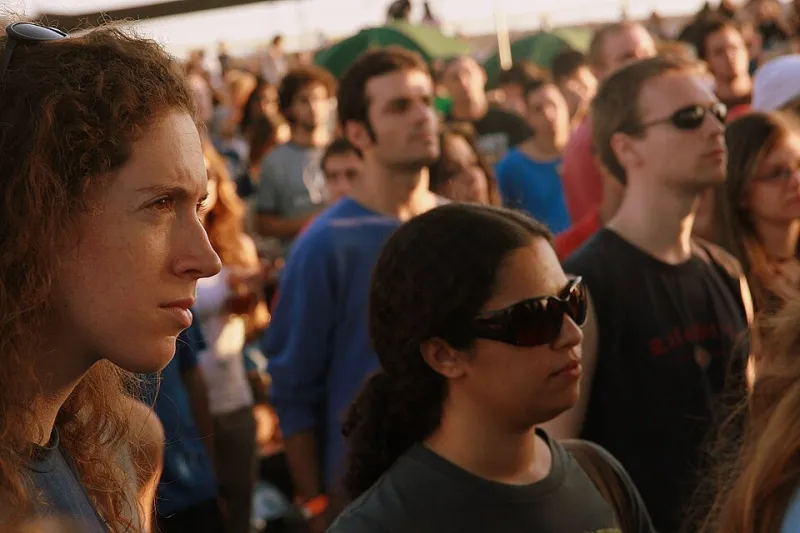
Photo: Asaf antman, CC BY 2.0, via Wikimedia Commons
Picture a busy Saturday afternoon at a shopping mall in Columbus, Ohio. Hundreds of people move through the corridors. Somewhere near the food court, a middle-aged man clutches his chest and slumps against a bench. Dozens of eyes turn toward him. And for several long, potentially fatal seconds—nobody moves.
This is not a scene from a cautionary film. Variations of it play out across the United States every single day. And the disturbing truth is that the presence of other people does not make a victim safer. In many documented cases, it makes them significantly more vulnerable.
Understanding why requires a brief but important journey into the human brain—and what happens to it when urgency collides with uncertainty.
The Science Behind Standing Still
In 1964, the murder of Kitty Genovese in New York City sparked one of the most consequential investigations in social psychology. Researchers John Darley and Bibb Latané designed a series of experiments to understand why bystanders failed to intervene in emergencies when others were present. Their findings gave rise to what is now known as the bystander effect—the well-documented phenomenon in which individual responsibility diminishes as group size increases.
The mechanism at work is called diffusion of responsibility. When a person witnesses an emergency alone, the moral weight of inaction falls entirely on their shoulders. When ten people witness the same event, each individual unconsciously assumes that someone else will handle it. The responsibility, in essence, evaporates into the crowd.
But diffusion of responsibility is only part of the story. Cognitive scientists have identified at least two additional forces that compound the problem.
The first is pluralistic ignorance—the tendency for individuals to look to others in ambiguous situations to gauge the appropriate response. If the people around you appear calm, your brain interprets the situation as less serious, even when the evidence in front of you suggests otherwise. In an unfamiliar emergency, we unconsciously outsource our threat assessment to strangers who are doing exactly the same thing.
The second is decision paralysis. Emergencies present a sudden, high-stakes decision point with incomplete information and no time to deliberate. The prefrontal cortex—the region of the brain responsible for rational decision-making—can become overwhelmed, causing a temporary cognitive freeze. This is not cowardice. It is a neurological response to an environment the brain was not specifically trained to navigate.
Why Even Prepared People Hesitate
Here is a sobering reality for anyone who has completed a first aid or CPR certification course: training in technique does not automatically translate into training for action. Many certified individuals still experience significant hesitation when confronted with a real emergency, precisely because their preparation focused on what to do rather than when to decide.
The decision to call 911 may seem trivially simple in a calm classroom setting. In the field, however, it is embedded in a cascade of competing thoughts: Is this real? Is someone else already calling? Will I look foolish if I'm wrong? Should I do something physically first? Each of those questions consumes precious seconds.
Research published in emergency medicine literature consistently shows that delays in calling emergency services—even delays measured in single minutes—dramatically reduce survival rates in cardiac arrest, stroke, and severe hemorrhage scenarios. The call is not a secondary action. In many emergencies, it is the most important action a bystander can take.
Rewiring Your Brain Before the Emergency Happens
The encouraging news is that the psychological barriers described above are not immovable. They are patterns of thinking, and patterns can be interrupted—but only if the interruption is prepared in advance.
The following strategies are grounded in behavioral psychology and emergency medicine research. They are designed to be practiced before you ever encounter a crisis.
Pre-Commit to a Personal Protocol
One of the most effective ways to defeat decision paralysis is to eliminate the decision entirely. Mental rehearsal—the deliberate practice of imagining yourself responding to an emergency—creates what psychologists call an implementation intention: a pre-formed plan that activates automatically under stress.
Try this exercise: once a week, spend two minutes mentally walking through a scenario. Visualize yourself in a public space. Someone collapses. Before you assess anything else, your first action is to call 911. Rehearse the words you will say. Rehearse pointing to a specific person nearby and assigning them a task. The more vividly and repeatedly you rehearse this sequence, the more automatic it becomes under pressure.
Name the Responsibility Explicitly
Diffusion of responsibility thrives in anonymity. It dissolves the moment responsibility is made explicit. If you are ever in a crowd during an emergency and you are not the one calling, point directly at a specific individual—not the group—and say clearly: "You in the red jacket—call 911 right now."
This technique, widely taught in advanced bystander training programs, works because it collapses the diffusion. That individual can no longer assume someone else will act. The same principle applies to yourself: when you witness an emergency, state it internally or aloud—"I am calling 911"—before you do anything else. Naming your role short-circuits the freeze.
Reduce Ambiguity With a Simple Threshold
Plualistic ignorance flourishes in ambiguous situations. One way to counteract it is to establish a personal action threshold in advance. A useful rule of thumb: if you are asking yourself whether something is an emergency, treat it as one. The cost of an unnecessary 911 call is minimal. The cost of an unplaced one can be irreversible.
Emergency dispatchers in the United States are trained to help callers assess situations in real time. You do not need to be certain before you dial. That is precisely what dispatchers are there for.
Learn the Language of Activation
Fear of saying the wrong thing is a surprisingly common barrier to calling for help. Many bystanders delay because they are uncertain how to describe what they are seeing. Practicing a simple, three-part statement removes that obstacle: where you are, what you are observing, and what the person looks like. You do not need a diagnosis. "I'm at the corner of Fifth and Main. A man in his fifties has collapsed and is unresponsive" is everything a dispatcher needs to set emergency services in motion.
What Every Community Gains When Individuals Prepare
The bystander effect is, at its core, a collective problem with an individual solution. When each person in a community takes personal responsibility for their own psychological preparedness, the aggregate effect is a neighborhood, a workplace, or a school that responds faster and more effectively to crises.
Organizations like Save Heroes exist precisely because this kind of preparation cannot be left to chance. Emergency response skills—including the mental skills—must be taught, practiced, and normalized before they are needed.
The next time you are in a crowded space, take a quiet moment to notice the people around you. Any one of them could need your help before the hour is out. The question is not whether you would want to help. The question is whether your brain has been given the tools to act when it matters most.
You already have the instinct. Now give it a plan.
Save Heroes is committed to equipping everyday Americans with the knowledge, skills, and psychological readiness to respond when lives are on the line. Explore our resources on emergency preparedness and community education at saveheroes.org.