Collapse on the Sidewalk: The Critical Decisions Every Bystander Must Make in the First 60 Seconds
You have rehearsed the chest compressions. You know the ratio. You may have even practiced on a mannequin in a community center gymnasium. But when a stranger drops to the pavement in front of you at a farmers market or a football game, the reality of that moment is rarely as clean as the training scenario. There is noise, fear, uncertainty—and a cascade of decisions that no one warned you about.
True emergency readiness is not simply memorizing a technique. It is developing the judgment to apply that technique correctly, at the right moment, for the right person. This article is for those who want to move beyond the checklist and become genuinely prepared for the chaos of a real collapse.
The First Question Is Not "Should I Start CPR?"
Most people assume that when someone falls unconscious, the immediate answer is to begin chest compressions. That instinct, while well-intentioned, can actually cause harm if applied indiscriminately.
The first question a bystander must ask is simpler and more fundamental: Is this person responsive?
Approach the individual and tap their shoulders firmly. Shout clearly: "Are you okay?" If there is no response, your next task is to assess whether they are breathing. Tilt the head back gently, lift the chin, and look, listen, and feel for no more than ten seconds. Normal, regular breathing means cardiac arrest is likely not occurring. Gasping—sometimes called agonal breathing—is not normal breathing and should be treated as a sign of cardiac arrest.
This distinction matters enormously. A person who has fainted due to low blood pressure, a seizure, or a sudden drop in blood sugar may be unconscious but breathing adequately. Starting chest compressions on a person with a beating heart can cause serious injury, including broken ribs and internal trauma.
Call First or Compress First? Understanding the Sequence
In the United States, the standard guidance from the American Heart Association is clear: for adults, call 911 before beginning CPR unless you are alone and the victim is a child or infant. The reasoning is practical—dispatchers can guide you through the process in real time, and getting emergency medical services en route is non-negotiable.
If you are not alone, assign the 911 call explicitly. Do not say "someone call 911." Point directly at a specific bystander and say, "You—call 911 right now and come back to tell me they're on the way." Diffusion of responsibility is a well-documented phenomenon: when a task is left to a crowd, individuals assume someone else has handled it. Specificity saves lives.
While one person calls, the rescuer with the most training should begin compressions immediately upon confirming unresponsiveness and absent or abnormal breathing. Every second of delay reduces the likelihood of survival. Brain cells begin dying within four to six minutes of oxygen deprivation.
Recognizing What Cardiac Arrest Actually Looks Like
Cardiac arrest is frequently misidentified—or missed entirely—because bystanders expect it to resemble a dramatic movie scene. In reality, the person may not clutch their chest. They may simply stop mid-sentence and crumple. They may twitch, which is sometimes confused with a seizure. Their face may turn an unusual color.
The defining features of cardiac arrest are:
- Unresponsiveness to voice or physical stimulation
- Absent or abnormal breathing (gasping counts as abnormal)
- No detectable pulse (though pulse-checking is no longer emphasized in lay rescuer training because it is unreliable without practice)
If all three indicators are present, treat it as cardiac arrest and act accordingly.
Contrast this with a fainting episode, where the person typically regains consciousness within a minute or two and begins breathing normally. A seizure involves rhythmic muscle convulsions and usually resolves on its own, after which the person is often confused but breathing. A stroke may cause sudden collapse but the person often remains conscious and responsive, even if unable to speak clearly.
The ability to distinguish between these scenarios is what separates a trained responder from someone who simply knows how to perform compressions.
The Recovery Position: An Underappreciated Life-Saving Skill
If a person is unconscious but breathing normally—meaning cardiac arrest has been ruled out—the appropriate response is not CPR. It is the recovery position.
The recovery position is designed to keep the airway open and prevent the person from aspirating vomit or saliva, which is a genuine risk in an unconscious individual. Here is how to perform it:
- Kneel beside the person and place their nearest arm at a right angle to their body, elbow bent, palm facing upward.
- Bring their far arm across their chest and hold the back of their hand against their near cheek.
- With your other hand, pull up their far knee so the foot is flat on the ground.
- Keeping their hand pressed to their cheek, pull on the bent knee to roll them gently toward you, onto their side.
- Adjust the upper knee so the hip and knee are at right angles.
- Tilt the head back slightly to keep the airway open and ensure the mouth is angled downward to allow fluid to drain.
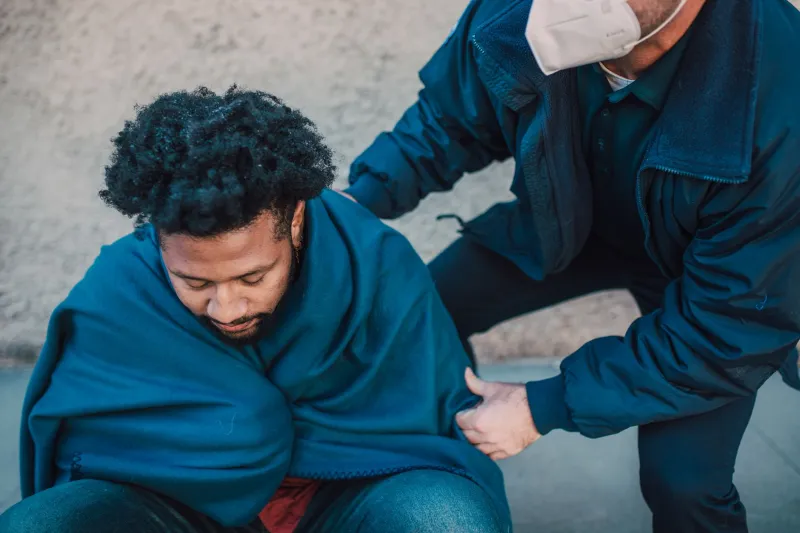
Stay with the person, monitor their breathing continuously, and wait for emergency services. If their condition changes—if breathing stops or becomes abnormal—reassess immediately and be prepared to begin CPR.
When the AED Enters the Picture
Automatic External Defibrillators are increasingly common in American public spaces—airports, shopping malls, schools, gyms, and sports arenas often have them mounted on walls. If someone nearby knows where the AED is located, send them to retrieve it the moment cardiac arrest is suspected.
An AED does not require extensive training to operate. The device provides spoken instructions and will not deliver a shock unless it detects a shockable rhythm. Using it promptly, before EMS arrives, can dramatically increase survival odds. Studies consistently show that early defibrillation combined with high-quality CPR represents the most effective bystander intervention available.
Developing the Mindset of a Prepared Responder
The gap between knowing CPR and being able to respond effectively in a real emergency is wider than most people realize. That gap is bridged not by memorizing more techniques, but by cultivating the habit of situational awareness and deliberate decision-making.
Practical steps you can take today include:
- Locate the nearest AED in buildings you frequent and note how to access it quickly.
- Practice the recovery position with a family member so the movement becomes familiar.
- Take a hands-on CPR and first aid course from a certified provider, refreshing your skills every two years.
- Mentally rehearse scenarios: What would you do if someone collapsed at your child's soccer game? At your office? At a restaurant?
Emergency preparedness is not a one-time event. It is an ongoing commitment to being the kind of person your community can count on when the worst happens.
The Ordinary Hero's Advantage
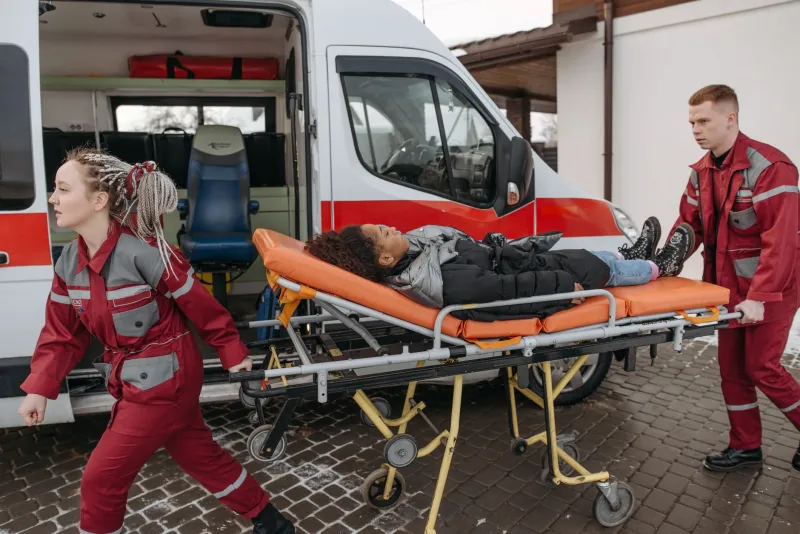
Professional first responders are invaluable. But they cannot be everywhere. The minutes before an ambulance arrives are often the most consequential minutes of a person's life—and the only ones during which a bystander has any influence.
At Save Heroes, we believe that ordinary Americans, equipped with the right knowledge and the confidence to act, are among the most powerful forces in public health. Cardiac arrest survival rates in communities with high rates of bystander intervention are measurably better than in those without. That is not a statistic—it is a reflection of what happens when neighbors choose to be prepared.
The next time you witness a collapse, you will not have time to look anything up. What you will have is what you practiced, what you thought through in advance, and the willingness to step forward. Make sure all three are ready.