The Conversation That Could Save Your Street: Encouraging CPR Training in Your Neighborhood
A Number Worth Sitting With
Every two minutes, someone in the United States experiences a cardiac arrest outside of a hospital setting. That translates to more than 1,000 people per day — neighbors, coworkers, parents watching their children's soccer games, strangers in grocery store parking lots. The survival rate when bystanders intervene with CPR before paramedics arrive is two to three times higher than when no intervention occurs. Yet according to the American Heart Association, fewer than 40 percent of cardiac arrest victims receive any bystander CPR.
The gap between those two realities is not primarily a training gap. It is a conversation gap.
Most Americans who have never learned CPR are not opposed to learning it. They simply have never been asked. They have never had a friend explain why it mattered, never had a neighbor organize a Saturday morning session, never had someone in their community make the subject feel approachable rather than clinical and intimidating.
This is where everyday heroes — people like you — become genuinely irreplaceable.
Why Peer Encouragement Outperforms Institutional Outreach
Public health campaigns promoting CPR training have existed for decades. Hospitals run awareness initiatives. Fire departments host open houses. The American Heart Association invests significantly in national messaging. And yet the adoption rate among American adults remains stubbornly low — approximately 18 percent of the adult population holds a current CPR certification, according to a 2021 estimate from the Sudden Cardiac Arrest Foundation.
Research in behavioral health consistently demonstrates that personal, peer-level encouragement produces higher rates of behavior change than institutional messaging. A recommendation from a trusted neighbor carries more psychological weight than a billboard. A text from a friend saying, "I just took a CPR class and it was easier than I expected — want to come to the next one?" is more persuasive than any public service announcement.
This is not a flaw in how Americans process information. It is a feature of how human communities have always functioned. Social trust, shared identity, and personal relationships form the infrastructure through which life-saving knowledge travels most efficiently.
The implication is clear: if you have already taken a CPR course, you are already positioned to be one of the most effective advocates for expanding that training in your community.
Addressing the Barriers Honestly
Before considering how to invite others into CPR training, it helps to understand the specific hesitations they are likely to hold. These are not excuses — they are legitimate concerns that deserve direct, respectful responses.
"I might do it wrong and make things worse." This is the most common fear, and it is worth addressing plainly. The American Heart Association's guidelines confirm that performing CPR — even imperfectly — is vastly better than doing nothing. Hands-Only CPR, which involves chest compressions without rescue breathing, is now the recommended approach for untrained bystanders and has been shown to be as effective as conventional CPR in the first few minutes of cardiac arrest. The threshold for helping is far lower than most people assume.
"I don't have time for a full certification course." Hands-Only CPR can be demonstrated in under two minutes. Full CPR and AED certification courses through the American Red Cross or the American Heart Association are typically completed in two to three hours, with many offered on evenings and weekends. Online blended-learning formats allow participants to complete the instructional component at home before a brief in-person skills session.
"That kind of thing doesn't happen in my neighborhood." Cardiac arrest does not observe neighborhood boundaries. It occurs in rural communities, suburban cul-de-sacs, and urban apartment buildings at roughly equivalent rates. More than 70 percent of out-of-hospital cardiac arrests happen in private residences — meaning the most likely person to need CPR from you is a member of your own household.
"I'm not strong enough" or "I'm too old." CPR technique can be adapted for individuals with physical limitations. Instructors are trained to work with participants across a wide range of physical abilities. Age and physical fitness are not disqualifying factors.
How to Start the Conversation
The most effective CPR advocates are not those with the most polished talking points. They are the ones who share their own experience honestly and extend a specific invitation.
Consider these approaches:
Share your own story. If you have taken a CPR course, describe what it was actually like — the atmosphere, the duration, how you felt afterward. Specificity is more persuasive than statistics. "I was nervous going in, but by the end I felt like I could actually help someone" lands differently than any fact about survival rates.
Make it about someone they love. Most people who resist CPR training are not thinking about strangers — they are thinking about themselves. Reframe the conversation: "If your dad had a cardiac arrest at Thanksgiving dinner, would you know what to do for the four minutes before the ambulance arrived?" This is not a manipulation tactic. It is an honest reflection of why this training matters.
Extend a specific invitation, not a general suggestion. "You should really learn CPR" is easy to defer indefinitely. "There's a free two-hour class at the library on the 14th — do you want to go together?" is actionable. Specificity collapses the distance between intention and action.
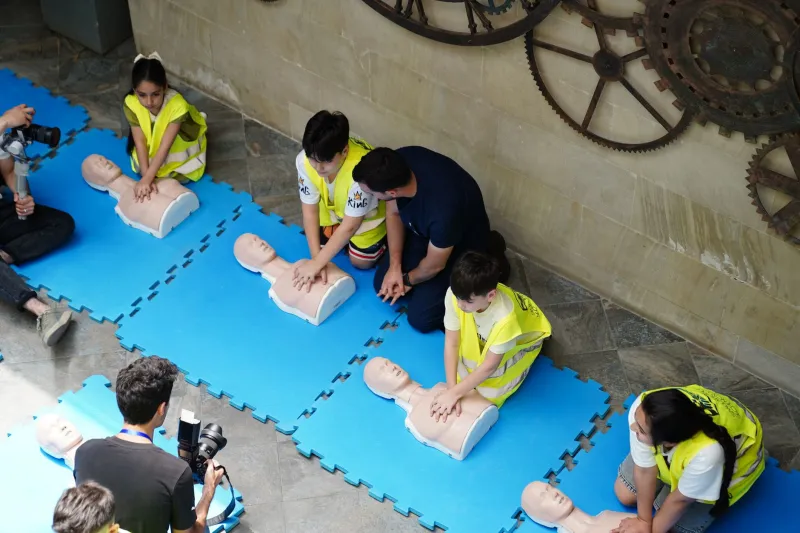
Use group dynamics. People are more likely to attend training as part of a group. Organizing a session for a neighborhood association, a faith community, a parent-teacher organization, or a workplace team dramatically increases participation. The social context provides both motivation and accountability.
Organizing a Community Training Event
If you are ready to move beyond individual conversations and create a broader learning opportunity, the following resources make the process more manageable than it may initially appear.
- The American Heart Association's Hands-Only CPR training kiosks are available in select public locations, and the organization offers resources for community training facilitation at heart.org.
- The American Red Cross provides free and low-cost CPR/AED training courses nationwide, including options for group bookings. Community organizations can request dedicated sessions at redcross.org.
- PulsePoint Foundation offers a community program that trains neighborhoods in CPR and connects trained responders with nearby emergencies through a smartphone application.
- Local fire departments and hospitals frequently offer free community CPR events, particularly during September, which is designated as National Preparedness Month.
When organizing a group session, choose a venue that feels familiar and low-pressure — a community center, a church hall, a neighbor's garage. Provide light refreshments. Keep the tone conversational. The goal is to remove every friction point between your neighbors and this knowledge.
The Ripple Effect of One Conversation
In communities where peer-driven CPR training has taken hold, the results are measurable. King County, Washington — which has invested heavily in community CPR education and achieved one of the highest bystander CPR rates in the country — demonstrates a cardiac arrest survival rate nearly double the national average. The difference is not primarily technology or response time. It is the density of trained, willing, prepared people within any given neighborhood.
That density builds one conversation at a time. It builds when someone who learned CPR last spring mentions it casually to a coworker. It builds when a parent at a school pickup mentions a free Saturday class to three other parents. It builds when a retiree organizes a session for her apartment building's common room.
At Save Heroes, we hold a foundational belief: the capacity to save a life should not be confined to those who wear a uniform. It belongs to every person willing to learn, and every community willing to teach. The conversation that makes that possible may be one you are already equipped to start.
Begin it today.